Mass Effect
ASCENSIONREVIEW
Drez
9/7/2025
Galaxies Written in Cigarette Burns
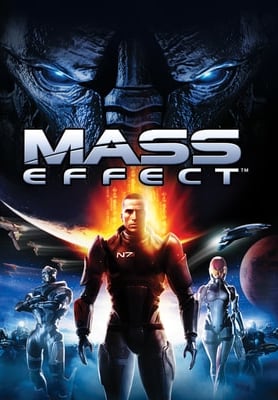
Mass Effect doesn’t introduce itself with fireworks. It slides in, half smirk, half stern, like a noir detective who knows exactly what you’re hiding in your pocket. It doesn’t beg for your attention, it takes it, like a cab ride that suddenly turns into a chase scene. The remaster sharpens those edges, brushes the dust off the trench coat, and leaves you standing there wondering why games today feel like TikToks with loot boxes stapled to them. This is a game from when BioWare still made universes, not pipelines. You play Commander Shepard, the “you” is optional but let’s be honest, most of us went with male Shepard because Mark Meer’s voice has that strange, monotone charm, like a guy trying not to yawn while telling you the galaxy is ending. The world building hits instantly. BioWare walked away from Knights of the Old Republic and instead of sulking, they built their own mythology. And they built it with conviction. You feel it in the dialogue, the codex entries, the sterile planets that look like someone forgot to order trees, but even in their emptiness, you sense a system, a structure. This universe doesn’t bend around you. You bend around it.
The story is simple enough if you reduce it to bones: rogue villain, ancient threat, big finale. But that’s like calling The Godfather “a movie about Italians in suits.” The magic is in the tone. It’s a sci fi opera spliced with Cold War paranoia, a spacefaring crime drama with alien diplomats arguing over bureaucracy while extinction looms like a knife at your throat. The crew is the heart, though. Liara, who I romanced, is all blue awkwardness and genuine vulnerability, a biotic powerhouse wrapped in shy academic stammering. Garrus feels like a buddy cop partner who never left your side, the guy who’ll either save your life or accidentally shoot the radiator. Wrex, well, Wrex is what happens if a tank got drunk and decided to apply for Medicare. These characters aren’t side quests; they’re ballast. They anchor Shepard in a way most modern games forget to even attempt. And then there are the choices. Not the fake “press X to hug or Y to slap” kind. The kind that sit in your chest for weeks. I saved the Rachni Queen, which felt less like an altruistic move and more like tossing a live grenade into the future and hoping it doesn’t go off in my lap. And that ending decision, no spoilers here, but if you’ve got a conscience, it will bruise you. BioWare was cruel back then. Cruel and brilliant.

91
File: Q4R-25-00010-S91-EXA
The Clunk and the Glory
Now for the blunt edge: the gameplay. If you told me the combat was “just okay,” I’d nod and pour another drink. Cover shooting works fine, abilities are flashy, and guns do what guns do. But it’s messy. A little floaty. Not bad, not broken, just functional. The Mako sections are another beast: annoying yet stupidly fun. Like driving a shopping cart with tank treads while someone throws fireworks at you. You’ll hate it, you’ll laugh, and then you’ll hate it again. The real devil hides in the inventory. It’s horrific. A spreadsheet masquerading as a menu, where you’ll drown in duplicate shotguns and armor until you want to eject Shepard out the airlock just to make the scrolling stop. Even the remaster didn’t fix this; they just added a better looking shovel to the mountain of junk. But here’s the twist: you forgive it. Because the moment to moment mechanics aren’t what keep you strapped to the chair. It’s the rhythm of mission to mission, the tension of dialogue choices, the feeling that you’re carving your name into a galaxy that doesn’t care whether you survive it. That’s the real loop.
Painted Steel and Neon Choirs
Graphically, the Legendary Edition does its job. It still looks like a remaster, not a rebirth, but it holds up. Faces aren’t wax dummies anymore; lighting feels cinematic, and the Normandy glows like a cathedral in orbit. Sure, some planets remain as sterile as an abandoned parking lot, but at least they sparkle now. The soundtrack, though, that’s not a remaster. That’s a relic of genius. It’s all pulsing synths, lonely echoes, and music that makes you want to stare out a window at stars you’ll never reach. The main theme is practically a time machine: one note and you’re back in 2007, sitting closer to the TV than your eyes can handle, believing that video games had finally figured out how to feel like movies without the guilt of skipping cutscenes. Voice acting is across the board solid, even if Shepard himself sometimes sounds like he’s reading off the back of a cereal box. The rest of the cast carries weight, personality, and enough spark to keep the dialogue alive even when the exposition dumps start piling up. And yeah, the dumps are there. This is BioWare. They can’t resist telling you about the mineral composition of a moon you’ll never visit.
Drez
A Universe of Its Own
Mass Effect didn’t invent branching narratives, morality meters, or sci-fi melodrama. What it did was stitch them together into something that felt coherent and alive. The game’s identity isn’t in its combat or its menus, it’s in the illusion of control. The idea that your Shepard is your Shepard, that your decisions matter even if the outcomes are already coded in some designer’s spreadsheet. It’s also one of the last times BioWare felt dangerous. Before they slid into studio purgatory, they had that spark, that willingness to risk clunky systems and dense lore if it meant building a universe you’d want to live in. Or at least one you’d want to haunt. Compared to today’s safer, cleaner, algorithm-friendly titles, Mass Effect feels almost punk. A little broken, sometimes boring, often brilliant. It’s the sort of game that doesn’t just ask for your attention, it dares you to commit.
The Weight of the Galaxy
So who is Mass Effect 1 really for? Not the tourist who wants constant dopamine hits. Not the impatient gamer looking for streamlined progression. It’s for people who still care about sitting in a captain’s chair and actually listening to what their crew has to say. People who like their sci fi with baggage, with clunk, with heart. A story that grabs you by the throat, world building that feels like a history book you’d actually read, and characters who stay with you long after the credits. Combat that limps, inventory that deserves trial at The Hague, and planets that sometimes feel like they were generated by an intern on their lunch break. But here’s the thing: none of that ruins it. Because the game still sings. Even now, remastered and reintroduced to a world that mostly forgot how to slow down, it holds. It’s not perfect. It’s better than that. It’s unforgettable. Mass Effect 1: Legendary Edition doesn’t just remind you why BioWare mattered. It reminds you why you play these damn things in the first place. Not for efficiency. Not for polish. But for the chance to stare down an alien council, pick a side, and live with the consequences. For the weight of choices, the sting of regret, and the rare feeling that maybe, just maybe, you made a dent in something bigger than yourself.